
Updated: Sept. 2, 2026
Purpose and Overview
Much more than a PKU test
Newborn screening (NBS) consists of a panel of tests done shortly after a baby is born. These tests check for serious health problems that may not be easy to see at first. If these problems are not found and treated early, they can cause serious health issues, delays in learning and growing, or even death. Early detection helps doctors start treatment right away. NBS can help your baby stay healthier in the future. Each year, newborn screening helps find treatable conditions in about 15,000 babies in the U.S. In South Carolina, newborn screening is required by law under SC Code of Laws Title 44.
NBS consists of three main tests:
- Blood Spot Test (Heel Prick Test)
- A healthcare provider pricks the newborn’s heel to collect a few drops of blood (within 24 - 48 hours of life).
- The blood is placed on a special filter paper card and sent to the public health laboratory for analysis.
- The laboratory screens for many conditions, including organic acid, fatty acid oxidation, amino acid, endocrine, hemoglobin, and others (e.g., cystic fibrosis, galactosemia, and more). See the complete list of conditions screened for using the blood spot test.
- Hearing Screening (First Sound)
- Hearing screening is done using Otoacoustic Emissions (OAE):
- A tiny earphone plays soft sounds, and a microphone measures the ear’s response.
- The test is painless, non-invasive, and takes just a few minutes.
- Hearing tests can be performed while the baby is asleep.
- For babies delivered at a hospital, this screening is done before discharge.
- For babies born outside of a hospital setting, screening is done by one month of age.
- For more information, contact Tara Carroll: carroltp@dph.sc.gov, (803) 898-0708
- Hearing screening is done using Otoacoustic Emissions (OAE):
- Pulse Oximetry Screening (for Critical Congenital Heart Defects - CCHDs)
- A small sensor is placed on the baby’s hand and foot to measure oxygen levels in the blood.
- This test is performed at the hospital or birth facility when the baby is at least 24 hours of age and before discharge.
- Low oxygen levels may indicate a heart problem, requiring further tests.
- Heart defects are the most common types of birth defects.
- Babies born with these conditions are living longer and healthier lives, and data shows improved survival over time.
- For more information, contact Heather Blackwell: blackwhr@dph.sc.gov, (803) 898-3885
Newborn Screening Provider Responsibilities
Who This Applies To
Physicians, Nurse Practitioners, Certified Nurse Midwives, Licensed Midwives, and Physician Assistants
Core Responsibilities
- Collect specimens: The attending provider (or designee) must ensure newborn screening specimens are collected for every infant under their care.
- Refusals: Neonatal Screening for Inborn Errors of Metabolism and Hemoglobinopathies, Sections 44-37-30 and 44-37-35 of the South Carolina Code of Laws requires:
- Every child born in South Carolina is required to have a newborn screen.
- Parents/legal guardians may only exempt testing based on religious grounds and must sign a religious exemption/refusal form if they decline the newborn screen:
- DPH 1804 - Newborn Screening Dried Blood Spot Screening Refusal Form (pdf)
- This form is also offered in Spanish, Russian, Ukrainian, Portuguese, and French.
- The hospital must keep a copy of the refusal form and send a copy to the DPH NBS Program by either fax or email:
- Fax a scanned copy to: (803) 898-0337; or
- Send via encrypted email to: NBS@dph.sc.gov
- Please include "DPH PHI" in the subject line. To send the email securely, follow your facility’s email encryption process.
- Mail the original to:
Newborn Screening
SC DPH Public Health Laboratory
8231 Parklane Road
Columbia, SC, 29223
- DPH 1804 - Newborn Screening Dried Blood Spot Screening Refusal Form (pdf)
- Confidentiality: Test information is confidential and may be released only to:
- The infant’s physician or authorized staff
- The child’s parent or legal guardian
- The child (at 18 years or older)
Parent and Caregiver Education
South Carolina Code of regulations 60-80 (formerly 61-80) requires hospitals, midwives, and other birthing facilities to educate parents and caregivers about newborn screening by:
- Requiring education
- Must include information about the conditions screened, the screening process, and the importance of early detection and treatment.
- Providing materials
- Give expectant parents and caregivers a Newborn Screening For Your Baby’s Health handout. This brochure is also available in Spanish, Russian, Ukrainian, Portuguese, and French.
- To order printed brochures for your practice, please contact the DPH Educational Materials Library (EML) at (803) 898-3539 or do so online via the Educational Materials Library product order site.
- Supporting families
- Address any questions or concerns expectant parents or caregivers may have and refer them to DPH’s Newborn Screening Program webpage for further information.
- HRSA- Parent Communication Best Practices (pdf): This document from the Health Resources and Services Administration (HRSA) is a guide for healthcare providers on how to effectively talk with parents or caregivers when a newborn has an out-of-range screening result.
Follow-Up and Communication
- Notify families: Inform parents or legal guardians of all screening results, both normal and abnormal.
- Repeat testing: If a specimen is unsatisfactory or a repeat test is required, collect and submit a new specimen as soon as possible.
- Abnormal results:
- Begin medical follow-up and diagnostic testing immediately.
- Refer to pediatric specialists when needed. View the list of pediatric specialists (pdf).
- If prompt referral or treatment is not possible, notify the Newborn Screening follow-up team at (803) 898-3192.
- Reporting:
- List of Reportable Conditions (LORC)
- South Carolina Law (44-29-10) and Regulation 60-20 require reporting of specified conditions to the area health department.
- Providers must report all results to the Newborn Screening follow-up team, whether the infant is diagnosed with a condition, cleared after confirmatory testing, or expired.
- Reports must include the final diagnosis, treatment start date, and clarification if the initial result was a false positive or false negative.
- How to report results:
- Download the Reporting Form
- Inborn Errors of Metabolism and Hemoglobinopathies Reporting Form (pdf)
- Request a copy by emailing NBSFollowup@dph.sc.gov
- Complete the Form
- Please be sure to fill out all fields accurately.
- Submit the Form
- You may return the completed form through one of the following methods:
- Secure email: NBSFollowup@dph.sc.gov
- Please include "DPH PHI" in the subject line. To send the email securely, follow your facility’s email encryption process.
- Fax: (803) 898-0337
- Secure email: NBSFollowup@dph.sc.gov
- You may return the completed form through one of the following methods:
- Need Help?
- If you have any questions or need assistance completing the form, please contact our team at (803) 898-3192
- Download the Reporting Form
- How to report results:
- List of Reportable Conditions (LORC)
List of Newborn Screening Conditions Tested on the South Carolina Bloodspot Screening Panel
View condition-specific information sheets and additional details.
| 2,4 Dienoyl-CoA Reductase Deficiency (DE RED) | Holocarboxylase Synthetase Deficiency (MCD) |
| 2-Methyl-3-Hydroxybutyric Acidemia (2M3HBA) | Homocystinuria (HCY) |
| 2-Methylbutyrylglycinuria (2MBG) | Hypermethioninemia (MET) |
| 3-Hydroxy-3-Methylglutaric Aciduria (HMG) | Isovaleric Acidemia (IVA) |
| 3-Methylcrotonyl-CoA Carboxylase Deficiency (3-MCC) | Krabbe Disease (globoid cell leukodystrophy) |
| 3-Methylglutaconic Aciduria (3MGA) | Long-Chain L-3 Hydroxyacyl-CoA Dehydrogenase Deficiency (LCHAD) |
| Argininemia (ARG) | Malonic Acidemia (MAL) |
| Argininosuccinic Aciduria (ASA) | Maple Syrup Urine Disease (MSUD) |
| Benign Hyperphenylalaninemia (H-PHE) | Medium/Short-Chain L-3 Hydroxyacyl-CoA Dehydrogenase Deficiency (M/SCHAD) |
| Beta-Ketothiolase Deficiency (BKT) | Medium-Chain Acyl-CoA Dehydrogenase Deficiency (MCAD) |
| Biopterin Defect in Cofactor Biosynthesis (BIOPT-BS) | Medium-Chain Ketoacyl-CoA Thiolase Deficiency (MCAT) |
| Biopterin Defect in Cofactor Regeneration (BIOPT-REG) | Methylmalonic Acidemia (Cobalamin Conditions) (Cbl A,B) |
| Biotinidase Deficiency (BIOT) | Methylmalonic Acidemia (Methylmalonyl-CoA Mutase Deficiency) (MUT) |
| Carnitine Acylcarnitine Translocase Deficiency (CACT) | Methylmalonic Acidemia with Homocystinuria (Cbl C, D, F) |
| Carnitine Palmitoyl Transferase I Deficiency (CPT-IA) | Mucopolysaccharidosis Type-I (MPS I) |
| Carnitine Palmitoyl Transferase Type II Deficiency (CPT-II) | Mucopolysaccharidosis Type-II (MPS II) |
| Carnitine Uptake Defect (CUD) | Primary Congenital Hypothyroidism (CH) |
| Citrullinemia, Type I (CIT) | Propionic Acidemia (PROP) |
| Citrullinemia, Type II (CIT II) | S, Beta-Thalassemia (Hb S/ßTh) |
| Classic Galactosemia (GALT) | S, C Disease (Hb S/C) |
| Classic Phenylketonuria (PKU) | Severe Combined Immunodeficiency (SCID) |
| Congenital Adrenal Hyperplasia (CAH) | Sickle Cell Anemia (Hb SS) |
| Cystic Fibrosis (CF) | Spinal Muscular Atrophy (SMA) |
| Fabry Disease (FD) | T-cell related lymphocyte deficiencies |
| Galactoepimerase Deficiency (GALE) | Trifunctional Protein Deficiency (TFP) |
| Galactokinase Deficiency (GALK) | Tyrosinemia, Type I (TYR I) |
| Glutaric Acidemia, Type I (GA-1) | Tyrosinemia, Type II (TYR II) |
| Glutaric Acidemia, Type II (GA-2) | Tyrosinemia, Type III (TYR III) |
| Glycogen Storage Disease Type II (Pompe) | Very Long-Chain Acyl-CoA Dehydrogenase Deficiency (VLCAD) |
| Hemoglobinopathies (Var Hb) | X-Linked Adrenoleukodystrophy (ALD) |
Screening Process and Timeline
Specimen Collection
- Collect the dried blood spot specimen 24–48 hours after birth.
- If the newborn is in a NICU or is critically ill, collect:
- On admission if transfusion is expected or before transfer to a higher level of care.
- At 24–48 hours of age, regardless of TPN status (and before transfusion, if possible).
- Repeat at 28 days of age or at discharge for infants < 34 weeks or < 2000 g at birth, or if requested by the NBS follow-up program.
- Complete the DPH 1327 Blood Collection Card fully, accurately, and legibly.
- Always fill each circle completely with a single large drop of blood. Allow specimens to dry flat for 3–4 hours and avoid contamination or layering.
Packaging and Transport
- Ship specimens within 24 hours of collection; do not hold or batch specimens.
- Use the newborn screening daily courier service (Sunday–Friday for birthing hospitals) or a fast overnight service (FedEx/UPS Priority) for pediatric offices, midwives, etc.
- Alternatively, pediatric offices, midwives, and others can drop off specimens at a local SC Health Department.
- Place dried cards in official NBS envelopes. Do not use staples, tape, or plastic bags.
- Keep a daily shipping log: number of specimens, MRNs/names, courier, and time of pick-up.
Lab Analysis
- Specimens are accessioned and tested at the SC Public Health Laboratory.
- SC currently screens for 60 disorders, including metabolic, endocrine, hemoglobin, immunologic, and other genetic conditions.
- Certain abnormal results undergo second or third-tier confirmatory testing, either in-house or at partner labs (e.g., Greenwood Genetic Center, UCSF).
Results Reporting
- All results are posted to the DPH Newborn Screening eReports Portal.
- Abnormal results are reviewed by the DPH laboratory follow-up team. Abnormal results are sent directly to providers for clinical follow-up.
- In the case of a critical test result, the primary healthcare provider listed on the newborn screening card will be directly contacted by the Newborn Screening Program.
- Normal results are not called to the provider and are available to providers through the secure eReports portal.
Follow-Up
- Screening results are reported to the attending physician.
- If the infant is not under the listed physician’s care, the NBS follow-up program must be notified.
- Providers are legally responsible for ensuring families are notified, confirmatory testing is performed, and specialty care is arranged (DPH Regulation 60-80, Section E).
- Physicians must notify the NBS follow-up program of all children born in South Carolina who are diagnosed with a newborn screening condition.
- DPH 4474 - Inborn Errors of Metabolism and Hemoglobinopathies Reporting Form (pdf)
- For more information, please refer to the Reporting Newborn Screening Follow-Up Results/Reporting a Diagnosed Case section.
- To contact the NBS follow-up program, call (803) 898-3192 or email nbsfollowup@dph.sc.gov.
Collection Guidelines
Heel Stick Technique
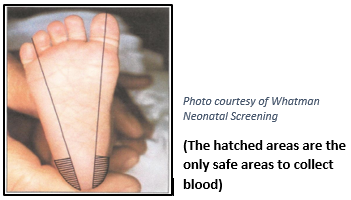
Only two sites are acceptable for collection:
- The most medial portion of the plantar surface of the heel
- The most lateral portion of the plantar surface of the heel
The following are unacceptable collection sites:
- Swollen or previously punctured areas
- The arch of the foot the curvature of the heel
- Fingers
- Earlobes
Filling Out the Form
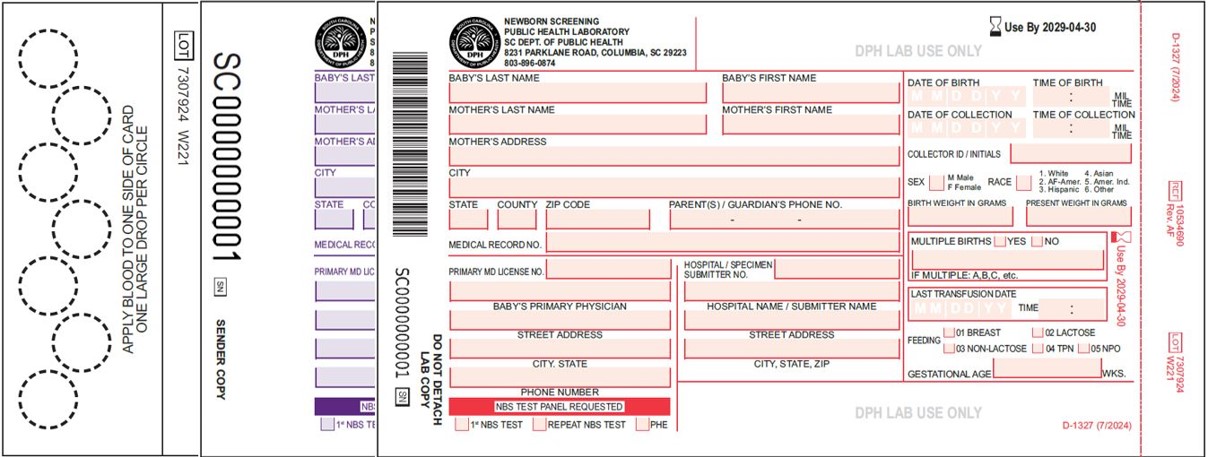
- Accurate information
- Please ensure all information is as accurate as possible.
- If a newborn screening lab report needs to be corrected, the requester must submit a DPH 4493 Correction Request for Submitted NBS Specimen Form (pdf)
- Legible information
- Print all information; no cursive writing.
- Use black or blue ballpoint pens only. Do not use a pencil.
- If an error occurs:
- Place a single line through the mistake and add the collector’s initials.
- Write the correct information in the available space if possible.
- If errors are extensive or there is not enough space for corrections, include a note with the card and attach a new card to the original using a paperclip (do not use staples).
- Missing information
- Physician fields cannot be left blank or entered as “Unknown”
- All dates and times are critical and needed for testing
- Birth date and time
- Collection date and time
- Transfusion date and time (if applicable)
NICU Collection Protocol for Preterm, Low Birth Weight and Sick Infants
First Specimen
- A specimen should be collected on admission if a blood transfusion is expected or if the infant is transferred to a higher level of care.
- At 24–48 hours of age, a specimen should be collected regardless of TPN status, and before transfusion if possible.
- Exception: If the TSH result is between 20 and 39, endocrinology recommends recollection at 2 weeks.
Second Specimen
A repeat specimen should be collected at 28 days of age or at discharge. This applies to:
- Infants born at less than 34 weeks gestation or weighing less than 2000 grams at birth, regardless of the initial specimen results.
- Infants with non-urgent abnormal results reported by the DPH NBS follow-up team.
- Repeat as soon as possible for:
- Infants with urgent abnormal results reported by the DPH Newborn Screening follow-up team.
- At the request of a specialist for a screening disorder.
For more information regarding the NICU Collection Protocol, please review the official departmental instructions in the South Carolina Newborn Screening Manual.
Infants Being Placed for Adoption
- Patient name on form:
- Use legal name at birth or adopted name.
- If unknown: Last name = birth mother’s last name, First name = “Adoption” (e.g., “Smith, Adoption”).
- If birth mother is not to be contacted:
- Mother’s name fields = lawyer, adoption agency, or legal guardian.
- Address & phone = lawyer, adoption agency, or legal guardian.
- Always enter when known:
- Physician contact information (complete name, address, and phone number).
- Infant medical record number.
Entering all known information helps the Newborn Screening Program locate the infant, alerts legal guardian or adoption agency of abnormal/potentially life-threatening results, and ensures the infant receives timely medical care.
- Questions? Contact NBSQI@dph.sc.gov or (803) 896-1140.
Age Matters
Any infant under a year old should be tested.
For infants over six months old, a modified testing panel is used. This panel includes:
- Amino acid disorders
- Biotinidase deficiency
- Galactosemia
- Hemoglobin disorders
- Spinal Muscular Atrophy (SMA)
- Severe Combined Immunodeficiency (SCID)
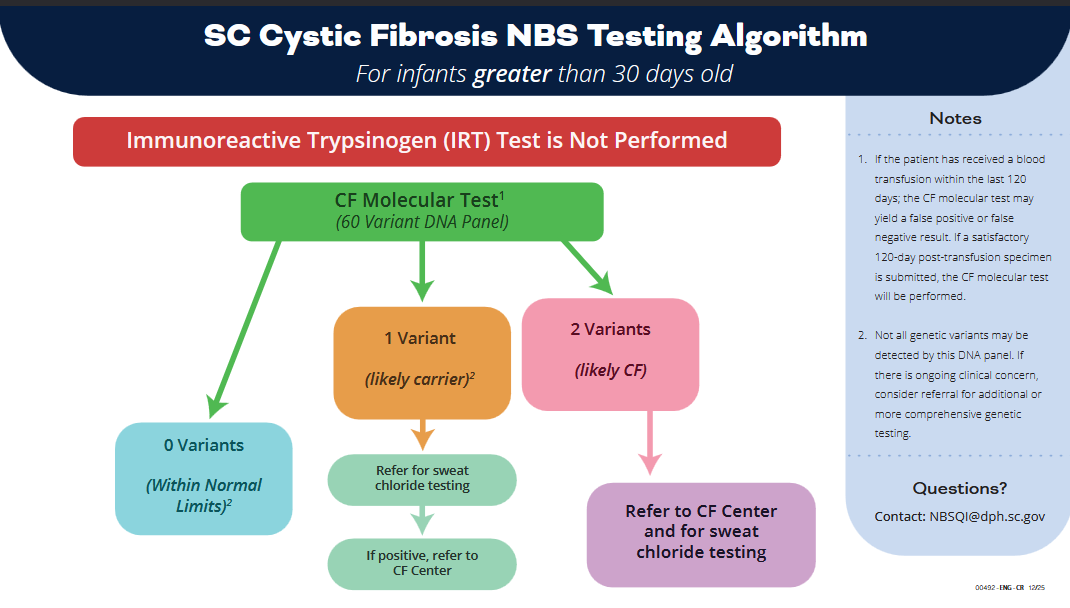
- Cystic Fibrosis - DNA panel only (applies to all infants over 30 days old)
The PHL can also test specimens from older babies, children, and adults, for the monitoring of select amino acids (such as phenylalanine and tyrosine levels for known PKU patients) and hemoglobin disorders and traits (such as Sickle Cell Disease).
Reporting Newborn Screening Follow-Up Results/Reporting a Diagnosed Case
- Download the Reporting Form
- Inborn Errors of Metabolism and Hemoglobinopathies Reporting Form (pdf)
- Request a copy by emailing NBSFollowup@dph.sc.gov.
- Complete the Form
- Please be sure to fill out all fields accurately.
- Submit the Form
- You may return the completed form through one of the following methods:
- Secure email: NBSFollowup@dph.sc.gov
- Please include "DPH PHI" in the subject line. To send the email securely, follow your facility’s email encryption process.
- Fax: (803) 898-0337
- Secure email: NBSFollowup@dph.sc.gov
- You may return the completed form through one of the following methods:
- Need Help?
- If you have any questions or need assistance completing the form, please contact our team at (803) 898-3192
Accessing Test Results
Dried Blood Spot testing
Healthcare professionals can retrieve completed newborn screening lab reports online anytime via Specimen Gate® eReports. Specimen Gate® eReports is a secure web portal that gives the end user the ability to view, download, and/or print patient lab reports for infants under their care 24/7/365 for a period of 1 year (from date specimen received).
- To access eReports, please visit the DPH Newborn Screening eReports Portal.
- This website is restricted to authorized users only. Providers seeking access should email nbslab@dph.sc.gov to request the DPH 3268 NBS Authorized User Agreement Form, which must be completed and returned.
- For results over 1 year old (from date specimen received), please email nbslab@dph.sc.gov.
Hearing Screening
For information on a baby’s hearing screen results, contact:
- Tara P. Carroll, MCD, CCC/A, Unit Manager, Newborn Hearing Screening, carroltp@dph.sc.gov, (803) 898-0708
Critical Congenital Heart Defects
For information on a baby’s heart screen results, contact:
- Heather Blackwell , Birth Defects Program Manager, blackwhr@dph.sc.gov, (803) 898-3885
Hemoglobin/Sickle Cell Test Results
The DPH Public Health Laboratory (PHL) can provide newborn Hemoglobin (Sickle Cell) screening results for individuals born in South Carolina. These results are required for NCAA athletic participation.
Patients Born in South Carolina
- Patients born in South Carolina, or parents/legal guardians (if child is under 18), requesting results:
- Option 1: Physician Request (Preferred & Fastest)
- A healthcare provider may request newborn Hemoglobin (Sickle Cell) screening results on behalf of their patient.
- Providers should submit requests on office letterhead using one of the following methods:
- Fax: (803) 896-3862 (Attn: LIMS)
- Encrypted email: NBSLab@dph.sc.gov
- Please include "DPH PHI" in the subject line. To send the email securely, follow your facility’s email encryption process.
- Information needed for requests:
- Child’s full name at birth
- Date of birth
- Mother’s full name at time of the child’s birth
- Request for “Hemoglobin (Sickle Cell) screen results”
- Contact name and phone number for the provider’s office
- A completed DPH 1878 Form MUST be signed by the patient/requestor and received by the PHL with the request before any results can be released to the provider.
- Turnaround time: Results are faxed back to the provider as soon as possible, typically within 24–72 hours after all required documentation is received.
- Option 2: Patient or Parent/Guardian Request
- Individuals may request their own results directly from the Public Health Laboratory.
- For individuals 18 years or older:
- Complete DPH 1623 - Authorization to Release Health Information:
- Provide a copy of a valid government-issued photo ID.
- Ensure the form includes:
- Full name at birth
- Date of birth
- Mother’s full name at time of birth (written in the space below “Patient’s Name and Date of Birth”)
- Request for "Hemoglobin (Sickle Cell) screen results”
- For individuals under 18 years old:
- A parent or legal guardian must complete and sign DPH 1623 - Authorization to Release Health Information:
- A copy of the parent/guardian’s valid photo ID must be included.
- Ensure the form includes:
- Full name at birth
- Date of birth
- Mother’s full name at time of the child’s birth (written in the space below “Patient’s Name and Date of Birth”)
- Request for “Hemoglobin (Sickle Cell) screen results”
- Note: Results can only be released to the legal adult patient, or to a parent/guardian when the patient is a minor.
- Individuals may submit required forms and identification by mail or in person.
- Mailing/In-Person Address:
DPH Public Health Laboratory – Attn: QA Office
Hayne Building
8231 Parklane Road
Columbia, SC 29223
- Mailing/In-Person Address:
- Processing time: By law, the PHL may take up to 30 days to complete a request. Typical processing time is 5–10 business days after receiving all required information.
- Option 1: Physician Request (Preferred & Fastest)
Patients Born Outside South Carolina
- If the individual was not born in South Carolina, please contact the newborn screening program in the state of birth.
- DPH cannot provide results for individuals born in another state.
- If newborn results cannot be located, consider:
- Testing through the individual’s healthcare provider.
- Testing services offered by a local sickle cell foundation.
Sickle Cell Foundations in South Carolina
These organizations may provide testing, counseling, or support services:
- James R. Clark Memorial Sickle Cell Foundation
1420 Gregg St., Columbia, SC
(800) 506-1273 - L.D. Barksdale Sickle Cell Anemia Foundation
645 South Church St., Spartanburg, SC
(864) 582-9420 - Orangeburg Area Sickle Cell Foundation
825 Summers Ave., Orangeburg, SC
(803) 534-1716 - COBRA Human Services Agency – Sickle Cell Program
3962 Rivers Ave., Charleston, SC
(800) 354-4704
Need Help?
If you have questions about requesting Hemoglobin (Sickle Cell) screening results, please contact the Public Health Laboratory Monday–Friday, 8:30 a.m.–4:30 p.m.
- Patricia Myers - (803) 896-3897
- Lynn Gleaton - (803) 896-0899
Result Reporting and Interpretation
Abnormal results are reviewed by the DPH laboratory follow-up team and sent directly to providers for clinical follow-up.
- In the case of a critical test result, the primary healthcare provider listed on the newborn screening card will be directly contacted by the Newborn Screening Program.
- The healthcare provider will need to contact the family to arrange for an additional screening or confirmatory testing.
DPH Newborn Screening eReports Portal
Normal results are not called and are available to providers through the secure DPH Newborn Screening eReports Portal, accessible 24/7.
- Providers and their staff can be granted access to eReports for results under 1 year old (from date specimen received).
- Fill out: DPH 3268 NBS Authorized User Agreement Form, (1 for each user)
- Submit the completed forms:
- Email to: nbslab@dph.sc.gov
- For help, call: (803) 896-9530
- For results over 1 year old (from date specimen received), please email nbslab@dph.sc.gov.
- Abnormal results carry clear interpretation protocols that are included in the SC Newborn Screening Manual; see “Criteria for Notification of Abnormal Results.”
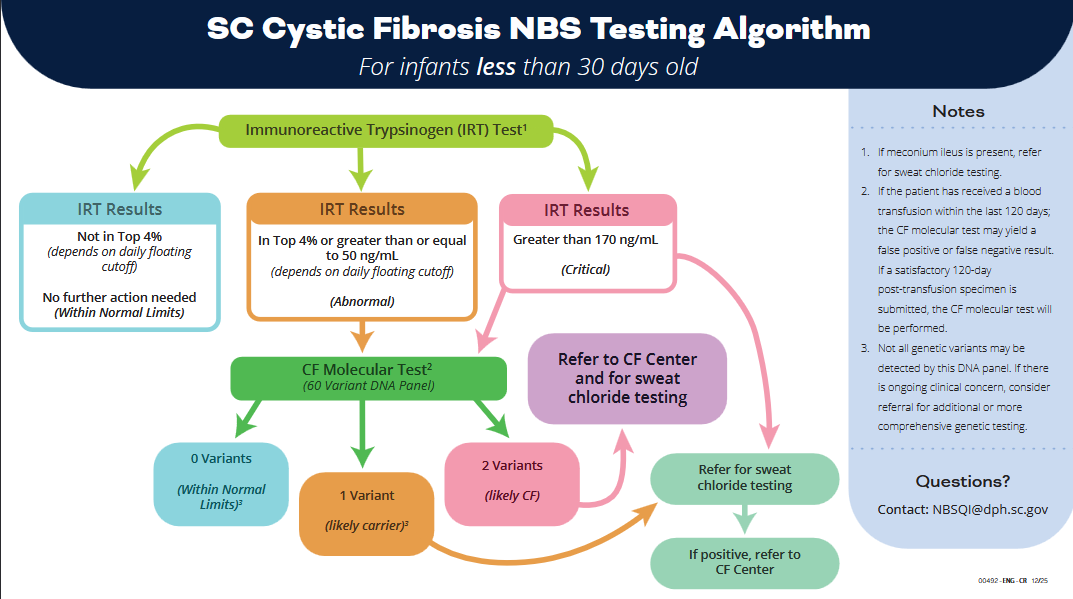
SC Cystic Fibrosis NBS Testing Algorithms
| Infants under 30 days old | Infants over 30 days old |
 |  |
Religious Refusals and Exemptions
Neonatal Screening for Inborn Metabolic Errors and Hemoglobinopathies, Sections 44-37-30 and 44-37-35 of the South Carolina Code of Laws requires:
- Every child born in South Carolina is required to have a newborn screen.
- Parents may only exempt testing based on religious grounds.
- Parents must sign a religious exemption/refusal form if they decline the newborn screen.
- Download the DPH 1804 - Newborn Screening Dried Blood Spot Screening Refusal Form (pdf)
- This form is also available in Spanish, Russian, Ukrainian, Portuguese and French.
- Download the DPH 1804 - Newborn Screening Dried Blood Spot Screening Refusal Form (pdf)
- The hospital must keep a copy of the refusal form and send the original to the DPH NBS Program via one of the following methods:
- Mail the original to:
Newborn Screening
SC DPH Public Health Laboratory
8231 Parklane Road
Columbia, SC, 29223 - Fax a scanned copy to: (803) 898-0337
- Send a copy via encrypted email to: NBS@dph.sc.gov
- Please include "DPH PHI" in the subject line. To send the email securely, follow your facility’s email encryption process.
- Mail the original to:
- One copy can be given to the parent or guardian. One copy is filed under consents at the health department/facility where the form was signed.
- The form will be retained according to DPH medical records retention schedule 18810 “Newborn Screening Follow-Up Documentation Records”, records group number: 169.
- The form will be retained by the PHL Newborn Screening Follow-Up Office for a period of 9 years.
- After this time period is met, the information will be stored at the State Records Center for 10 years and then destroyed.
Unsatisfactory Specimens
If a newborn screening specimen is received and determined to be unacceptable for any reason, it is classified as unsatisfactory. In such cases, our follow-up team will notify the infant’s healthcare provider by mail to request collection of a repeat specimen.
Training Flyers
- What is a Quantity Insufficient Unsatisfactory Specimen? (pdf)
- What is a Scratched & Abraded Unsatisfactory Specimen? (pdf)
- What is a Contaminated Unsatisfactory Specimen? (pdf)
- What is a Clotted or Layered Unsatisfactory Specimen? (pdf)
- Timeliness for Newborn Screening Success (pdf)
- Packaging and Shipping Newborn Screening Specimens (pdf)
- Newborn Screening Success for Pediatric Offices (pdf)
- Newborn Screening Quality Improvement Training (pdf)
Training Videos
- Newborn Screening Bloodspot Specimen Quality Check
- CLSI Newborn Screening Dried Blood Spot Collection
Supply Requests
If you are a healthcare professional in need of more DPH 1327 NBS Dried Blood Spot Collection Cards or manilla envelopes, please contact the Public Health Laboratory Supply Department: phl-supply@dph.sc.gov, (803) 896-0913.
Newborn Screening Bloodspot Training
The DPH State Public Health Laboratory can provide interactive hands-on newborn screening (NBS) training utilizing infant heel simulators, practice newborn screening cards, and other materials. Trainings are offered at no cost to all South Carolina providers.
Training topics covered:
- Overview of newborn screening
- SC conditions tested
- Specimen collection
- Identifying improper specimens
- Packaging & shipping
- Abnormal results
All levels of newborn experience are welcome. Trainees will receive a DPH Newborn Screening training certificate at the completion of the training.
Sign up for training by sending an email to nbsqi@dph.sc.gov or calling (803) 896-1140.
Training flyers:
- What is a Quantity Insufficient Unsatisfactory Specimen? (pdf)
- What is a Scratched & Abraded Unsatisfactory Specimen? (pdf)
- What is a Contaminated Unsatisfactory Specimen? (pdf)
- What is a Clotted or Layered Unsatisfactory Specimen? (pdf)
- Timeliness for Newborn Screening Success (pdf)
- Packaging and Shipping Newborn Screening Specimens (pdf)
- Newborn Screening Success for Pediatric Offices (pdf)
- Newborn Screening Quality Improvement Training (pdf)
Comments from past trainings:
- “Learned so much, staff made it comfortable, felt like a discussion with round table input and improvements.”
- “Awesome training! We loved hearing our site location stats and ways we can improve our collections!”
- “It was an excellent presentation with interactive education for staff. It was the right length and excellent material presented.”
Educational Resources for Providers
The South Carolina Newborn Screening Program offers free educational materials and resources to all healthcare professionals upon request.
For Providers
- Newborn Screening: Medical Provider Information Sheets
- Cystic Fibrosis Testing Algorithm Flow Chart (pdf)
- South Carolina Newborn Screening Manual
Newborn Screening Training Flyers
- What is a Quantity Insufficient Unsatisfactory Specimen? (pdf)
- What is a Scratched & Abraded Unsatisfactory Specimen? (pdf)
- What is a Contaminated Unsatisfactory Specimen? (pdf)
- What is a Clotted or Layered Unsatisfactory Specimen? (pdf)
- Timeliness for Newborn Screening Success (pdf)
- Packaging and Shipping Newborn Screening Specimens (pdf)
- Newborn Screening Success for Pediatric Offices (pdf)
- Newborn Screening Quality Improvement Training (pdf)
- Newborn Screening Materials Available (pdf)
External Resources
- Newborn Screening ACT Sheets and Algorithms: Provides downloadable guidance sheets and diagnostic algorithms to assist healthcare providers in managing various genetic conditions.
- Baby’s First Test: The most comprehensive source for information about newborn screening in the U.S. Includes condition details, state-specific screening info, and family stories.
- CDC - Newborn Screening: Public health guidance and education from the Centers for Disease Control and Prevention. Great for understanding the science behind screening.
- HRSA - Heritable Disorders: Learn about national policies and the Recommended Uniform Screening Panel (RUSP) from the Health Resources and Services Administration.
- HRSA - About Newborn Screening: This Health Resources & Services Administration page explains the essentials of Newborn Screening (NBS) in the U.S.
- Expecting Health: Works collectively with organizations, healthcare professionals, people, and communities to provide the right information at the right time - from planning a pregnancy to early infant care.
- NewSTEPs - NBS Disorders: Summarizes the disorders included in or under consideration for newborn screening and provides an interactive table of those conditions for program use.
Videos
- Newborn Screening Bloodspot Specimen Quality Check
- CLSI Newborn Screening Dried Blood Spot Collection
- Lunch and Learn- Krabbe Provider Training
For Parents
- Newborn Screening: Parent Information Sheets
- Newborn Screening For Your Baby’s Health handout (pdf)
- Baby’s First Test: The most comprehensive source for information about newborn screening in the U.S. Includes condition details, state-specific screening info, and family stories.
- HRSA - About Newborn Screening: This Health Resources & Services Administration page explains the essentials of Newborn Screening (NBS) in the U.S.
Becoming a New Submitter
Healthcare practices and facilities that wish to become a new submitter for newborn screening must complete the steps below to establish access and communication with DPH.
How to Apply
- Step 1: Email Required Information
- Send an email to NBSQI@dph.sc.gov with the following details:
- Clinic full name
- Complete clinic mailing address
- Clinic phone number
- Clinic fax number
- Clinic email address
- This information allows DPH to create your facility profile in the newborn screening system.
- Send an email to NBSQI@dph.sc.gov with the following details:
- Step 2: eReports Access
- DPH no longer mails printed newborn screening reports. All results must be accessed electronically and securely through the DPH Newborn Screening eReports Portal.
- To request access to the portal, each staff member needing access must complete an Authorized User and Confidentiality Agreement (Form 3268)
- Submit completed form(s) as instructed on the document
- This ensures compliance with privacy and data security requirements.
- Step 3: Await Confirmation
- Once your submission is received and processed, the DPH Laboratory will provide your account credentials and instructions for submitting newborn screening specimens.
Need Help?
- For questions or assistance with becoming a new submitter, please contact NBSlab@dph.sc.gov or call (803) 896-4777.
Need Supplies?
If you need to order supplies, such as DPH 1327 NBS Collection Cards or manilla envelopes, please contact the Public Health Laboratory Supply Department: phl-supply@dph.sc.gov, (803) 896-0913
Correcting a Newborn Screening Lab Report
If a newborn screening laboratory report contains incorrect patient or specimen demographic information, a request can be submitted to correct the report.
Steps to Submit a Correction
- Download the Correction Form
Obtain the DPH- 4493 - Correction Request for Submitted Newborn Screening Specimen Form (pdf). - Complete the Form
Fill out all required fields accurately. Incomplete or unsigned forms may delay processing. - Submit the Form
- Send the completed form along with:
- A copy of the original Newborn Screening Report to be corrected.
- Your site's official fax cover sheet.
- Submission Options:
- Fax: (803) 896-3862
- Encrypted email: NBSLAB@dph.sc.gov
- Please include "DPH PHI" in the subject line. To send the email securely, follow your facility’s email encryption process.
- Send the completed form along with:
Documents and Forms
- DPH 1804 - Newborn Screening Dried Blood Spot Screening Refusal Form (pdf)
- DPH 4474 - Inborn Errors of Metabolism and Hemoglobinopathies Reporting Form (pdf)
- DPH 3268 - NBS Specimen Gate eReport User Agreement Form
- DPH 4493 - Correction Request for Submitted NBS Specimen (pdf)
- Newborn Screening for Your Baby's Health (pdf)
Meetings and Recorded Sessions
References and Resources
- South Carolina Newborn Screening Manual: Detailed procedural manual (specimen collection, follow-up, provider responsibilities, appendices).
- South Carolina Newborn Screening Collaborative: A hospital–public health quality improvement initiative to improve specimen transport time and timeliness.
- South Carolina Neonatal Screening Regulations (60–80): State regulatory requirements for newborn metabolic and hemoglobinopathy testing.
- South Carolina Code §44-37-30 (Neonatal testing/blood sample storage/confidentiality statute): This state law discusses mandates, exemptions, confidentiality, and storage of newborn screening specimens.
- South Carolina Rare Disease Advisory Council: A resource hub for rare diseases in SC, linking to newborn screening information.
- CDC - Newborn Screening: Public health guidance and education from the Centers for Disease Control and Prevention. Great for understanding the science behind screening.
- Baby’s First Test - South Carolina: A family- and provider-focused site that shows how newborn screening works in SC (conditions, educational materials, and more).
- ACMG - American College of Medical Genetics and Genomics: Professional guidance and medical information on genetic testing and newborn screening practices from the American College of Medical Genetics and Genomics.
- HRSA - Heritable Disorders: Learn about national policies and the Recommended Uniform Screening Panel (RUSP) from the Health Resources and Services Administration.
- Expecting Health: Works collectively with organizations, healthcare professionals, people, and communities to provide the right information at the right time - from planning a pregnancy to early infant care.
- HRSA - Newborn Screening Results and Follow-Up: Detailed information on the interpretation of newborn screening results and recommended follow-up procedures. It outlines result categories for blood spot, hearing, and critical congenital heart disease (CCHD) screenings.
- HRSA - Communicating Out-of-Range Newborn Screening Results to Parents and Families (pdf): This resource serves as a tool to help providers navigate sensitive result conversations and support families effectively.
- Children and Youth with Special Health Care Needs (CYSHCN) Information for Healthcare Providers/Vendors: This page provides healthcare professionals with key CYSHCN resources, including outreach materials, reimbursement information, and required forms and policies. It also offers fee schedules, provider lists, and guidance to support the coordination of care for children and youth with special healthcare needs in South Carolina.
Contact Information
Contact the Newborn Screening Program
Division Director
Beth Bair, MS, PhD
Program Director
bairea@dph.sc.gov
(803) 896-0991
Administrative Support and NBS General Inquiries
Toshiro Washington
NBS Lab Administrative Assistant
washints@dph.sc.gov
(803) 896-0795